I was appointed Group CFO and Group CDO in April 2026. I will ensure that management remains firmly focused on capital efficiency and will promote data-driven management as we work toward sustainable improvement in corporate value across the Resona Group. As CFO, I will pursue the optimal balance among growth investment, shareholder returns, and financial soundness, while ensuring that management remains rigorously focused on ROE and the cost of capital. Under the new Medium-Term Management Plan (MMP) announced in March 2026, we will pursue “Our New Ways of Doing Business” in each area of our operations; in the financial domain, we will advance Capital Management aimed at accelerating a virtuous cycle of capital creation. We will strategically allocate expanding capital flows and accelerate disciplined investment, thereby further strengthening the virtuous cycle of channeling the capital thus created into the next phase of growth and shareholder returns.
Review of Results for the Fiscal Year Ended March 2026 (FY2025) and the Framework for FY2026 Annual Targets
In FY2025, a world with interest rates became the norm and Japan’s economy maintained a moderate recovery trend; at the same time, the materialization of geopolitical risks and other factors made it a year of further heightened uncertainty.
Against this backdrop, Gross operating profit (GOP) reached 808.8 billion yen (up 117.2 billion yen YoY), topping 800.0 billion yen for the first time in 19 years and marking the highest level since the Resona Shock of 2003. Net income attributable to owners of parent increased 45.3 billion yen YoY to 258.7 billion yen, surpassing 250.0 billion yen for the first time in 13 years, since FY2012. ROE rose 1.4 percentage points YoY to 9.2%.
Solid net interest income, progress in the sale of policy-oriented stock holdings and low credit costs, among other factors, lifted earnings above plan. This enabled us to deliver results exceeding guidance even while carrying out measures that will help stabilize our management foundation going forward, including addressing the amortization of the goodwill equivalent of Digital Garage stocks and rebalancing our securities portfolio to secure stable interest income over the medium to long term.
I would also like to explain the shareholder returns actions we announced in May 2026. We forecast dividends per share (DPS) for FY2026 of 37 yen per share for the full year, an increase of 8 yen YoY. This dividend increase is double last year’s increase of 4 yen. In addition, we announced the establishment of a share buyback program with an upper limit of 35.0 billion yen. Toward our total shareholder return ratio target of “50% or higher,” we intend to continue taking appropriate action in light of earnings progress and other factors. Shareholder returns are discussed in further detail later in this message.
In the FY2026 earnings targets announced in May 2026, we plan for net income attributable to owners of parent of 310.0 billion yen, up 51.3 billion yen YoY, and for ROE to reach the major milestone of 10%. Rather than relying on interest rate hikes, we will pursue growth in net interest income through expansion of our loan balance and more sophisticated ALM, while steadily building up fee income. We have formulated our plan for extraordinary items, including net gains on stocks and credit costs, on assumptions that take into account an uncertain business environment, such as the impact of inflation and heightened geopolitical risks, while aiming for a substantial increase in profit. By harnessing changes in the interest rate environment as a tailwind while strengthening our profit base itself, we will pursue sustained profit growth.
Income Framework Under the New MMP
Next, I will explain net income attributable to owners of parent under the new MMP, showing the factors behind increases and decreases over the three-year plan period. Under the new MMP, we are targeting 390.0 billion yen, an increase of approximately 130.0 billion yen from FY2025, the final fiscal year of the previous MMP (258.7 billion yen). Excluding one-time factors, this would be the highest profit level since the founding of the Resona Group.
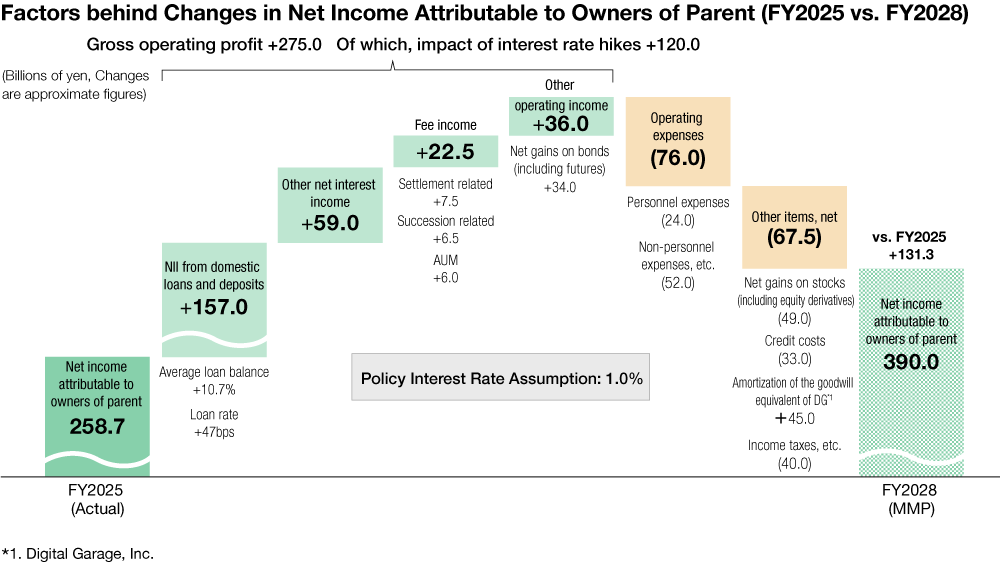
We expect Gross operating profit (GOP) to increase by 275.0 billion yen, driven by enhancing both the quality and volume of loans and Securities as part of more sophisticated ALM, together with the sustained expansion of fee income. We have assumed an impact of interest rate hikes of approximately 120.0 billion yen up to a policy interest rate of 1%, but beyond that we have also factored in upside from our own self-help efforts unrelated to interest rate hikes.
At the same time, while expanding front-loaded investment in human capital and IT, we aim to steadily capture the returns on those investments and, through continued rigorous cost discipline, bring OHR down into the 40% range as quickly as possible.
Possible Impact on Earnings with JPY Interest Rate Hikes (provisional calculation)
Should policy rate hikes advance further, we expect our balance sheet, which is highly sensitive to policy interest rate movements, to generate a positive effect on income, centered on net interest income from loans and deposits and interest income on securities.
Given the many variables involved—including the timing, pace and depth of monetary policy changes—the results of any simulation vary substantially with the assumptions used. As a reference based on a simplified calculation that does not take into account changes in asset and liability balances, the chart below shows the estimated impact of policy interest rate hikes on GOP (versus FY2023).
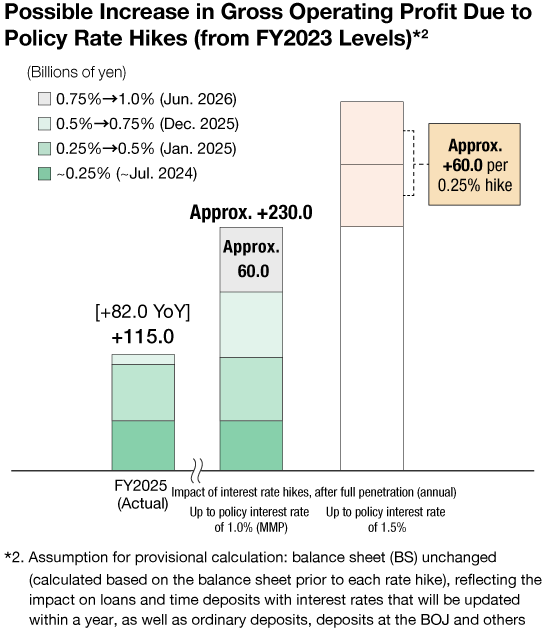
Assuming the full benefit of interest rate hikes up to a policy interest rate of 1% is realized, we estimate a cumulative positive impact of approximately 230.0 billion yen. Should the policy interest rate rise further still, we estimate that GOP would expand by approximately 60.0 billion yen for each 0.25% increase, and we believe an ROE of 14% would come into view if the policy interest rate were to reach 1.5%. Moreover, because changes in asset and liability balances and other such factors are not taken into account, further upside can also be expected. On the other hand, please note that this analysis only examines GOP sensitivity under certain assumptions, and therefore does not account for inflation-driven operating expenses or rises in credit costs, among other factors.
Capital Management
We entered a phase of full-scale capital utilization under the previous MMP, and there is no change to our basic policies of expanding growth investment and shareholder returns while maintaining financial soundness. To maximize corporate value, we will continue to strategically allocate our expanding capital flows and accelerate disciplined growth investment.
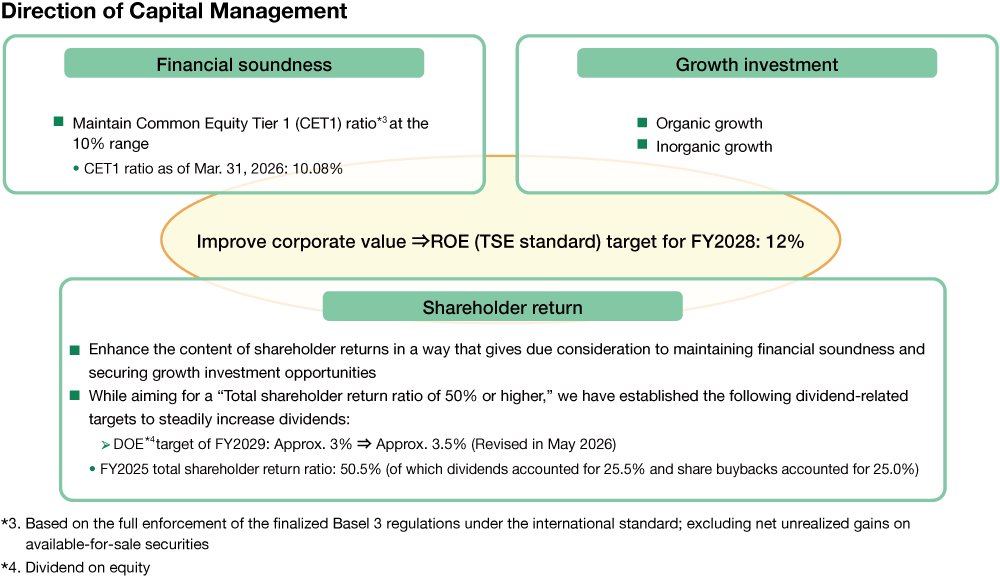
Under the new MMP, we clarified the minimum level, revising our target for the total shareholder return ratio from the previous “approximately 50%” to “50% or higher.” In addition, reflecting our upwardly revised ROE target, in May 2026 we raised our DOE target from the previous “approximately 3%” to “approximately 3.5%.” Raising our sights another notch, we will work to deliver stable and sustained dividend increases.
We also intend to continue carrying out share buybacks in a flexible manner. Considering the flexibility we will need in our future capital policy, we recognize that the current number of shares outstanding remains an issue to be addressed. We will continue to pursue sustained growth in earnings per share (EPS) through income expansion and the optimization of the number of shares outstanding.
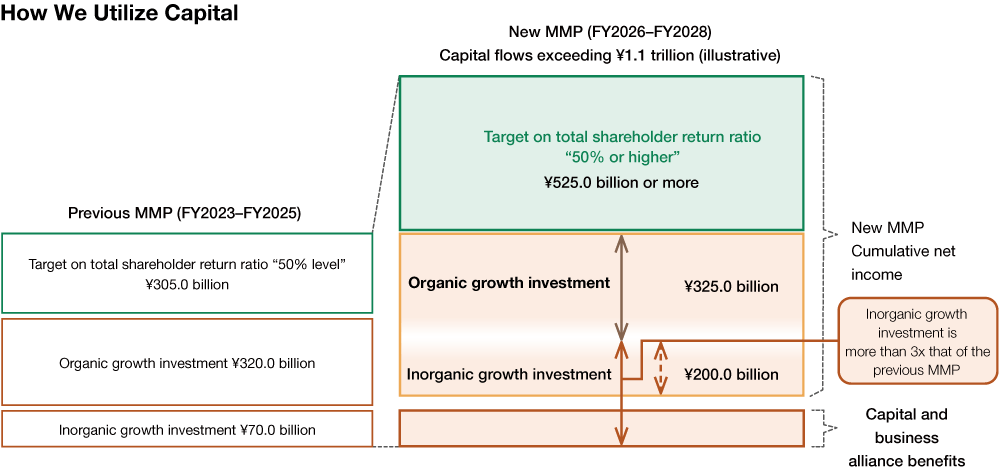
We have set out our “How We Utilize Capital” under the new MMP; in light of expanding capital flows, we will shift capital utilization into a higher gear. The left side of the diagram shows actual results during the previous MMP period, while the right side illustrates our vision for the new MMP period. Under the new MMP, we will deploy capital flows exceeding 1.1 trillion yen: organic growth investment, which was significantly increased under the previous MMP, will be maintained at a similar scale, while inorganic growth investment and returns to shareholders will each be substantially expanded.
Reduction of Policy-Oriented Stock Holdings
As part of the financial reforms that followed the injection of public funds in 2003, we moved ahead of our peers in reducing policy-oriented stock holdings. By the end of March 2005, we had reduced holdings by approximately 1 trillion yen on an acquisition cost basis, and we have continued negotiations with customers since then. We are currently proceeding with reductions under a six-year plan starting in FY2024 (the current plan). We will leverage the capital created through the reduction of policy-oriented stock holdings to accelerate our efforts to resolve customers’ issues and social issues, and to advance the structural reforms and platform enhancements needed to realize CX. Drawing on the income upside created by this virtuous cycle of capital, we are working toward sustainable expansion of returns to our shareholders as well.
- Plan for Reduction
(Released in May 2024) - Reduce over 2/3 of book value by the end of March 2030 compared to the end of March 2024
⇒ Bring the fair value-based ratio to consolidated net assets down to approximately 10% (reaching and passing the 20% level as early as the end of March 2028)
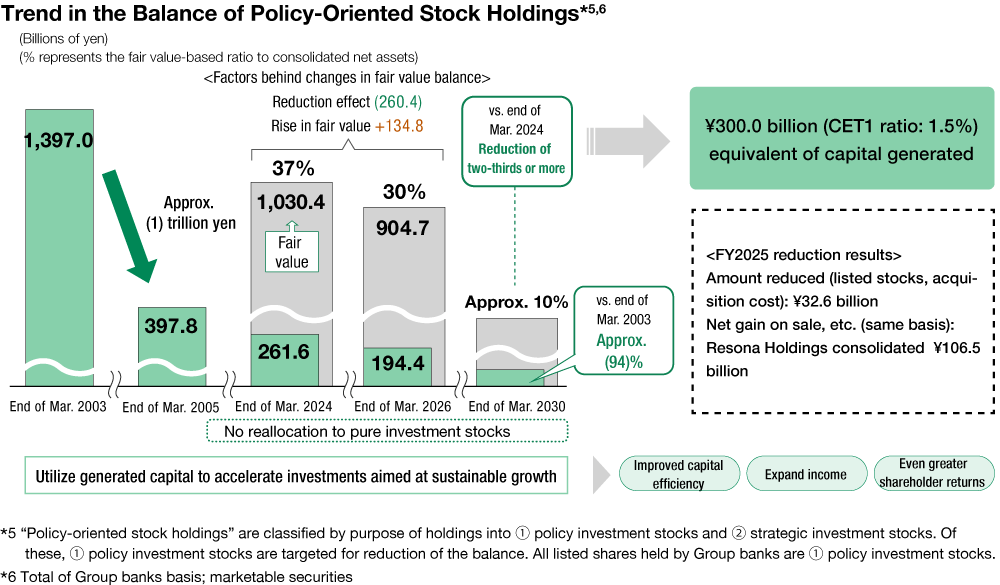
Under the current plan, by the end of March 2030, we aim to reduce the book value balance by more than two-thirds compared with the end of March 2024 and to bring the ratio of fair value balance to consolidated net assets to approximately 10%. In FY2025, we reduced holdings by 32.6 billion yen, bringing the cumulative reduction over the two years since the end of March 2024 to 67.2 billion yen (25%) on a book value basis. Progress against the plan stands at a solid 38%. Meanwhile on a fair value basis, the cumulative reduction effect over the two years exceeded 260.0 billion yen; however, fair value appreciation on the remaining holdings amounted to more than 130.0 billion yen, resulting in a net decrease in fair value of 125.6 billion yen. As a result, the ratio of fair value balance to consolidated net assets stood at 30% as of March 31, 2026, and we expect to reach and pass through the 20% level by the end of March 2028 at the earliest. We will continue to press ahead with reducing the balance.
Initiatives to Improve Corporate Value
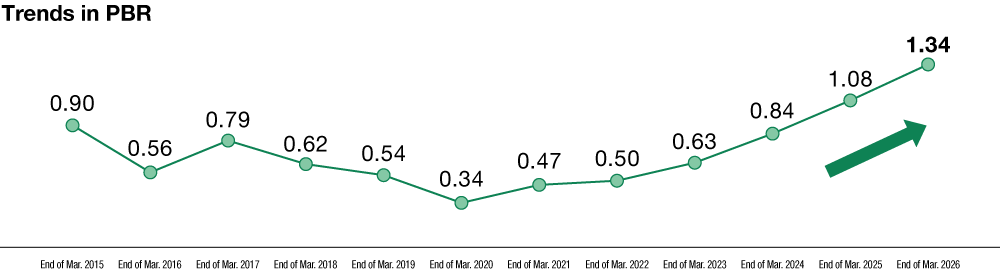
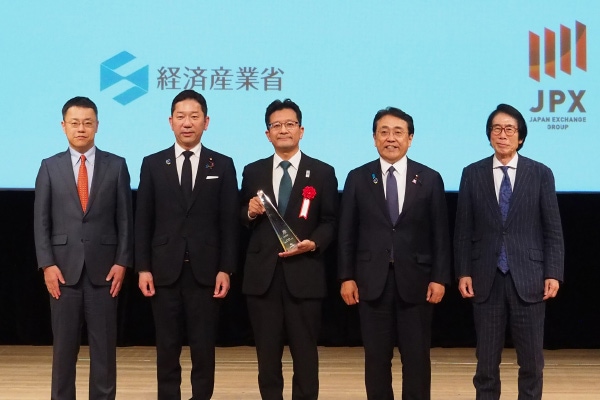
At the end of FY2025, our price book-value ratio (PBR) exceeded 1.3x and our market capitalization reached approximately 4 trillion yen. In May 2026, we became the first company in the banking industry to be selected for the “SX Brand 2026,” recognized as “a leading company that strengthens its capacity for sustainable generation of growth resources through sustainability transformation (SX) to improve corporate value.” We believe that continuing to work on both “improving ROE” and “reducing the cost of capital” in tandem will further enhance our corporate value and lead to a higher PBR as a reflection of market valuation.
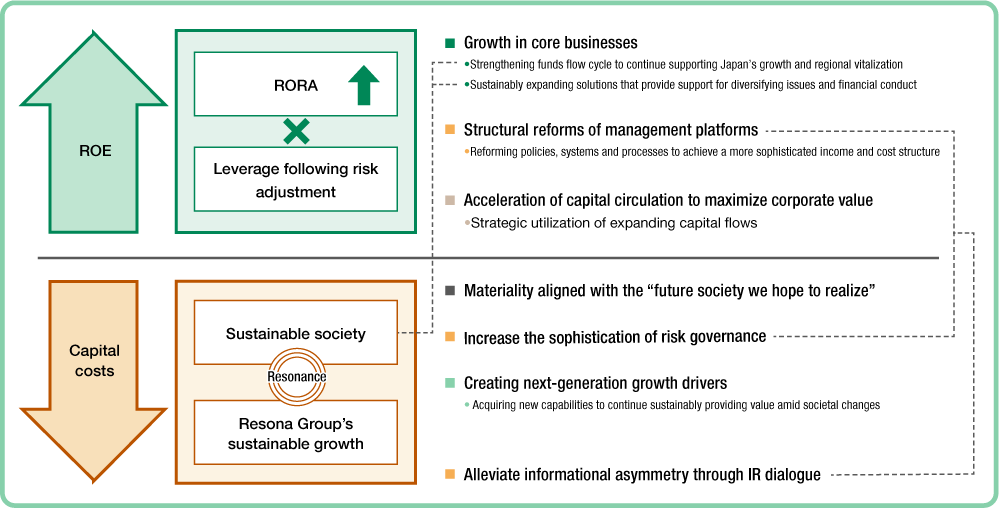
From the perspective of improving ROE, we will make effective use of capital to enhance both “profitability” and “asset efficiency.” We will work to improve RORA through growth in core businesses, while pursuing a lower OHR by advancing structural reforms of management platforms. Through the acceleration of capital circulation to maximize corporate value, we will expand growth investment while also working to enhance returns to our shareholders.
From the perspective of reducing the cost of capital, alongside business development aligned with Materiality and our ESG-related initiatives, we will actively work on creating next-generation growth drivers and on efforts to alleviate informational asymmetry through IR dialogue, thereby enhancing stakeholders’ understanding of the Group’s sustainable growth potential. In an era of heightened uncertainty, we will also aim to build a high-quality, stable earnings structure by managing risks appropriately.
May 2026
Selected for the SX Brand,
a first in the banking industry

Dialogue with Shareholders and Investors
Constructive dialogue with our shareholders and investors is one of the initiatives I place particular emphasis on as CFO. In FY2025, we again worked proactively to expand opportunities for dialogue. With institutional investors, we have engaged in ongoing dialogue through earnings presentations as well as one-on-one and small-group meetings, while also actively conducting overseas IR activities. For individual investors, we have worked to enhance opportunities for information provision through both face-to-face and digital channels, including online briefings and shareholder seminars. We will continue striving to deepen understanding of the Group and to build relationships of trust with our shareholders and investors.
In addition, the valuable feedback we receive from shareholders and investors is reported regularly to the Board of Directors and other bodies. We work to improve corporate value by deepening internal understanding of the market’s assessments of and expectations for the Group, and applying these insights to our management strategy and business operations.
Going forward, we will pursue a wide range of initiatives in search of “Our New Ways of Doing Business” as we work toward realizing the new MMP. We will strive to communicate the progress and outcomes of these efforts with a high degree of transparency. We also intend to reflect in our management the diverse perspectives and insights gained through dialogue with shareholders and investors, thereby enhancing the effectiveness of the new MMP. We look forward to your continued candid feedback.