Since April 2026, as Group CSO, Group CSuO, and Group CHRO, I have been responsible for integrating sustainability, human resources, and governance within the overall management strategy, and for implementing Materiality as part of our growth strategy.
To coincide with the launch of our new Medium-Term Management Plan (MMP), “Shift to the Next Stage — Three Years to Create Our New Ways of Doing Business,” Resona Group has reviewed its Materiality.
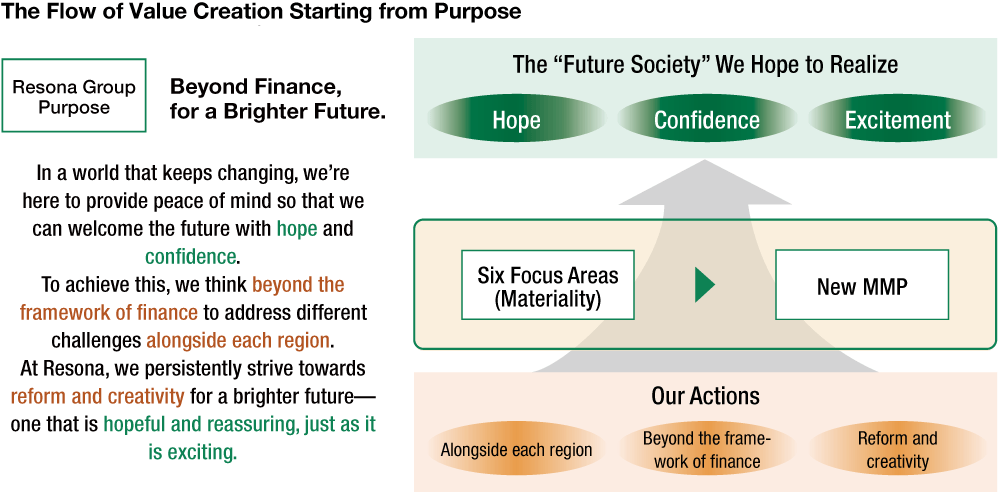
This is not about simply reorganizing social issues. Based on the future society we hope to realize, as embodied in our Purpose, “Beyond Finance, for a Brighter Future.” and the actions we are taking for that realization, it clearly defines the areas in which the Group creates value and the changes we must make within ourselves for the realization.
We are now at a turning point where the very nature of value creation must evolve. What is required of us goes beyond simply responding to change. It is to view social issues and our customers’ issues as growth opportunities, and to evolve the Group’s value proposition, earnings structure, and management foundation as a unified whole.
In my role, which spans strategy, sustainability, human resources, and governance, my priority is to ensure that this reform does not end as a one-time effort, but is instead implemented as an integral part of our management systems.
Starting from customers’ issues and the social issues that underlie them, to generate new value that transcends conventional frameworks, to nurture the human resources and organizations that can execute on this, and to connect them to a disciplined governance that supports bold challenges—I believe that embedding this entire chain of connections into our management is essential to making the new Materiality truly effective.
Continuing to Use Materiality as a Decision-Making Principle
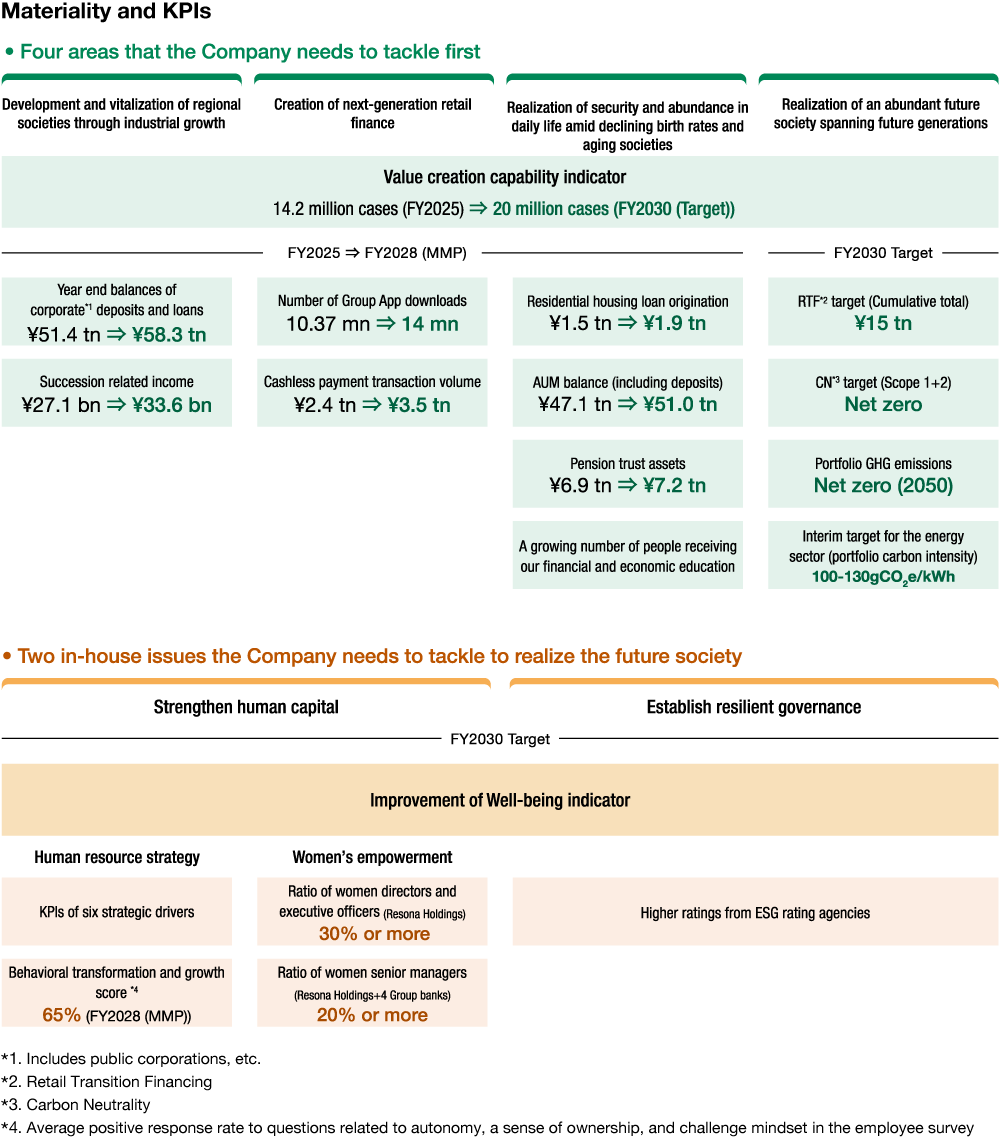
Our Materiality consists of four value creation domains and two management foundation themes.
Four domains, namely, “Development and vitalization of regional societies through industrial growth,” “Creation of next-generation retail finance,” “Realization of security and abundance in daily life amid declining birth rates and aging societies,” and “Realization of an abundant future society spanning future generations,” indicate where the Group will simultaneously generate social value and corporate value.
At the same time, “Strengthen human capital” and “Establish resilient governance” constitute the management foundation for executing that value creation and translating it into sustained results. In other words, the six Materiality themes are not parallel, stand-alone topics. We regard them as a management blueprint that shows where Resona will grow and what capabilities will drive that growth.
What matters is not the act of articulating Materiality itself, but continuing to apply it in day-to-day business decisions and management practices.
How do we frame the issues facing our customers and regional communities in each domain as business opportunities? What human resources, data, external partnerships, and risk management will be needed to realize those opportunities?
The new Materiality KPIs also incorporate business-domain indicators aligned with the new MMP. Through these, we will monitor progress and make course corrections as needed. By embedding Materiality into management processes in this way, we will advance the simultaneous pursuit of social value and corporate value not as individual initiatives, but as a management system.
Transforming Social Issues into Growth through “Beyond Finance”
In drawing up this management blueprint, changes in the external environment were a key assumption. Changes in the interest rate environment and demographics, social issues such as climate change, natural capital, and human rights, and advances in generative AI and data utilization are profoundly transforming the issues faced by our customers and regional communities.
If we are to turn these into opportunities for the Group to broaden the value we provide through “Beyond Finance” rather than viewing them solely as risks, it is essential that we do not treat social issues as matters external to our business.
We position sustainability not merely as a response to environmental and social themes, but as a perspective for envisioning new forms of value creation, starting from the issues facing our customers and regional communities. This is the Group’s implementation of “Beyond Finance,” and it is the fundamental philosophy for simultaneously enhancing social value and corporate value.
The key to implementing “Beyond Finance” is not simply adding something to existing financial services. It means starting from the issues of our customers and regional communities, combining our financial capabilities, trust banking functions, digital and data assets, AI, regional networks, and the strengths of external partners to deliver, as a unified whole, value that was previously fragmented. While individual initiatives may differ, the underlying philosophy is shared. By engaging more deeply in the lives and businesses of our customers and supporting them from the identification of issues through to their resolution and the building of ongoing relationships, we will create new forms of value creation that surpass the past.
For example, Supporting Customer Efforts to Promote Sustainability Transformation (SX) is not solely about addressing environmental concerns but also a theme that relates to new funding demand and the sustainable development of the regional economy. Our response to climate change, too, extends beyond risk management. It is an effort to support our customers through their transition and to contribute to the realization of an abundant future society spanning future generations. Instead of treating these themes as separate initiatives, link them to the allocation of management resources and business activities through Materiality—that is, I believe, a critical role for the CSO and CSuO.
Bridging Execution and Supervision to Enhance the Quality of Decision-making
At the same time, balancing challenges and discipline is essential for moving into a new stage of growth. Under the new MMP, we will pursue further growth in core businesses, while also working on creating next-generation growth drivers, structural reforms, and acceleration of capital circulation. While we are called upon to take on broader challenges than ever before, including co-creation with external partners, inorganic growth investment, and the use of data and AI, those challenges must be pursued under transparent and disciplined management. What is important here is to establish a closer link between executive strategy and supervision by the Board of Directors.
With the aim of strengthening the functions of the Corporate Governance Office, a new structure has been established in which the Deputy President and Representative Executive Officer serves as the officer in charge. This is intended to strengthen the unity between group strategy and corporate governance, and to ensure that discussions held by the Board of Directors and various Committees are more effectively utilized in the executive team’s implementation of strategy.
In implementing the new MMP and Materiality, the complexity of management decisions will increase significantly, spanning growth investment, external partnerships, human resource and organizational reform, and sustainability initiatives.
Therefore, using Materiality as a guiding principle, we need to clearly define what we view as opportunities, which risks we take, and which risks we mitigate. My role as the Executive in Charge of the Corporate Governance Office is to ensure that constructive discussions at Board of Directors meetings and various Committees are incorporated into executive decision-making, and to foster closer interaction between management and supervision, thereby balancing the speed of challenge with discipline of management. We intend to make even greater use of governance as a system for improving the quality of decision-making that leads to sustainable growth.
These initiatives are also important for enhancing corporate value from both financial and non-financial perspectives. In addition to steadily executing our growth strategy aimed at improving ROE, I think that deepening understanding of the Group’s sustainability and growth potential through Materiality-aligned business development, sustainability initiatives, strengthening of human capital, and the advancement of governance will also contribute to reducing the cost of capital. Placing sustainability at the center of business management is not only about enhancing non-financial information, but also about improving the quality of management to improve corporate value.
And when it comes to embedding Materiality into management, it is ultimately our human resources that serve as the starting point. No matter how well-crafted our strategies and systems may be, it is each employee who notices changes in our customers, identifies issues, devises solutions, and takes action. To ensure that Materiality is made effective, it is essential to encourage behavioral change in each individual and transform the corporate culture itself.
Advancing Human Resource Strategy to the Next Stage Through Corporate Culture Reform
The theme I advocate in our new MMP is “behavioral transformation and growth” of our employees.
Simply introducing well-designed initiatives will not transform our corporate culture. What matters is whether individuals are actually increasingly taking on challenges, and whether people are growing and the organization is changing as a result. In order to continue facing that reality head-on, I have placed “behavioral transformation and growth” at the center of our human resource strategy.
The Group has strengths such as the friendliness of our people, our warm corporate culture, and a work environment and systems that make it easy to work here. We have also received recognition for our diversity initiatives.
On the other hand, while our business performance continues to be solid thanks in part to the normalization of monetary policy, I am also conscious of organizational issues, such as a decline in employees’ initiative, sense of ownership, and challenge mindset. I recognize the need to transform our corporate culture in order to overcome these issues.
The environment surrounding the Group is undergoing significant change, including increasingly diverse and advanced customer needs and behavioral changes as well as accelerated technological innovation. In this environment, sustainable value creation cannot be achieved by simply extending past thinking and actions. I believe that, in order to steadily advance our business strategy, it is essential that behavioral changes in each individual employee serve as the starting point, and that corporate culture evolve as those changes accumulate.
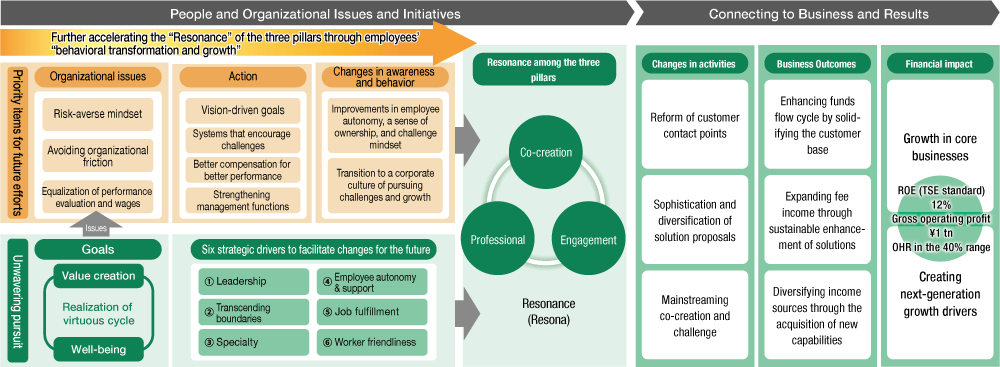
I regard the aforementioned organizational issues not only as risks but also as opportunities. Our human resource strategy aims to achieve a “sustainable virtuous cycle between value creation and well-being.” While continuing to implement various initiatives and human resource investments across the Six Strategic Drivers, we will accelerate the Resonance among the three pillars by overcoming organizational issues through employees’ behavioral transformation and growth. Beyond that, I believe that changes in Group-wide activities, such as the “reform of customer touchpoints,” the “sophistication and diversification of solution proposals,” and the “mainstreaming co-creation and challenge,” will emerge, powerfully supporting the “Growth in core businesses” and the “Creation of next-generation growth drivers” set out in the new MMP.
Human Resource Strategies Aimed at Supporting Our Pursuit of Value Creation as well as Employee Well-Being
For the Group, “human resources” are the driving force of value creation and the most vital asset underpinning our management strategy. Under our Purpose, “Beyond Finance, for a Brighter Future.,” and our Corporate Mission, we have been advancing a human resource strategy rooted in “Resonance” as we work toward realizing our Long-Term Vision, “Retail No.1.”
The foundation of this is an organizational culture of “Integrity,” “Diversity & Inclusion,” and “Pursuit of Reform.” Based on this foundation, we have steadily implemented initiatives aligned with the Six Strategic Drivers: Leadership, Transcending boundaries, Specialty, Employee autonomy & support, Job fulfillment, and Worker friendliness. At the same time, we have expanded our investment in human resources and have been working to build a foundation that enables every employee to maximize their potential through recruitment, training, compensation, and improvements to the work environment.
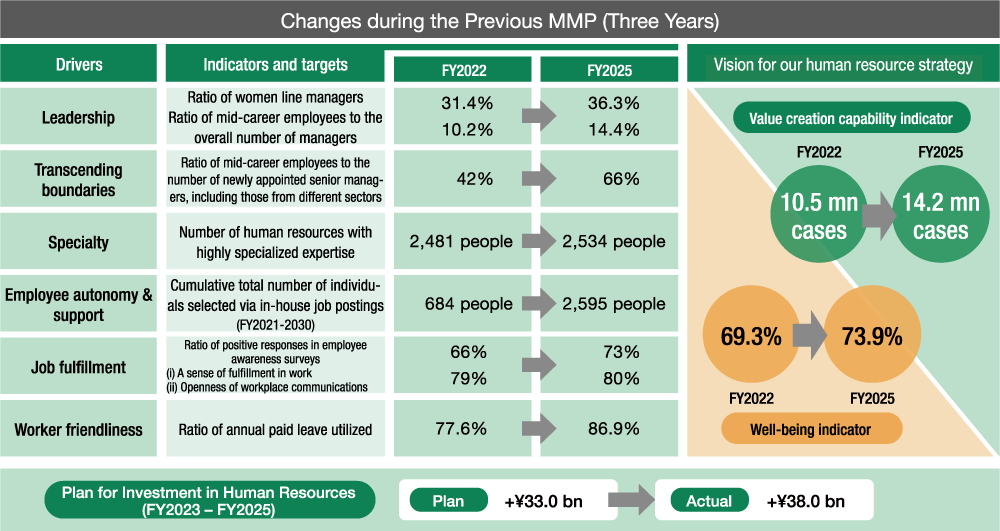
While it takes time for investment in human resources to produce visible results, we are making steady progress overall, and the indicators based on each driver are generally trending positively.
We have also established the “Well-being indicator,” a Materiality KPI, as an indicator for gauging employee well-being. This indicator is based on the ratio of positive responses in employee awareness surveys regarding the sense of fulfillment felt in work and private life. We have seen a steady improvement in this indicator.
The “sustainable virtuous cycle of value creation and well-being” that we aim to achieve through our human resource strategy remains unchanged in our new MMP. Going forward, we will continue to invest in human resources at a scale exceeding that of the previous MMP. In addition, to foster “behavioral transformation and growth” of employees, we will comprehensively review our approaches to goal-setting, evaluation, and compensation, and ensure that management puts these practices into action in day-to-day operations to embed them as organization-wide behavioral standards.
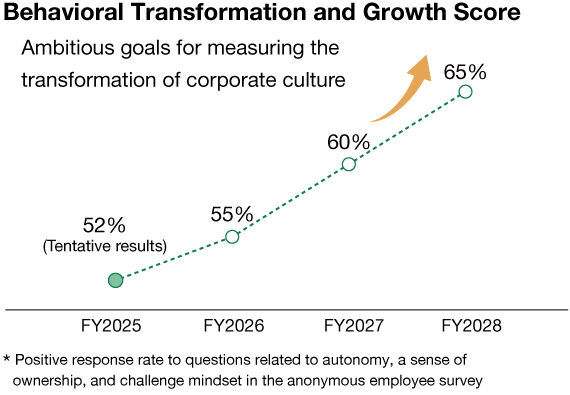
We have also established “behavioral transformation and growth” as an indicator to visualize changes in employee awareness and behavior. We will continuously monitor progress in reforming our corporate culture while enhancing the effectiveness of our initiatives.
Even in an era of rapid change, “human resources” remains the starting point for delivering value to our customers and regional communities. I will drive corporate cultural reform starting from “behavioral transformation and growth,” while further deepening the initiatives of human resource strategy we have built up over the years, thereby advancing both as a unified whole. And we will realize a “sustainable virtuous cycle between value creation and well-being.”